Science & History--We Help India

Thursday, April 26, 2007

Extrasolar planets may have diamond layers

Some extrasolar planets may be made substantially from carbon compounds, including diamond, according to a report presented this week at the conference on extrasolar planets in Aspen, Colorado. Earth, Mars and Venus are "silicate planets" consisting mostly of silicon-oxygen compounds. Astrophysicists are proposing that some stars in our galaxy may host "carbon planets" instead.

"Carbon planets could form in much the same way as do certain meteorites in our solar system, the carbonaceous chondrites," said Dr. Marc J. Kuchner of Princeton University, making the report in Aspen together with Dr. Sara Seager of the Carnegie Institute of Washington. "These meteorites contain large quantities of carbon compounds such as carbides, organics, and graphite, and even the occasional tiny diamond." Imagine such a meteorite the size of a planet, and you are picturing a carbon planet.

Planets like the Earth are thought to condense from disks of gas orbiting young stars. In gas with extra carbon or too little oxygen, carbon compounds like carbides and graphite condense out instead of silicates, possibly explaining the origin of carbonaceous chondrites and suggesting the possibility of carbon planets. Any condensed graphite would change into diamond under the high pressures inside the carbon planets, potentially forming diamond layers inside the planets many miles thick.

Some of the already known low- and intermediate-mass extrasolar planets may be carbon planets, which should easily survive at high temperatures near a star if they have the mass of Neptune. Carbon planets would probably consist mostly of carbides, thought they may have iron cores and substanial atmospheres. Carbides are a kind of ceramic used to line the cylinders of motorcycle engines among other things.

The planets orbiting the pulsar PSR 1257+12 are good candidates for carbon planets; they may have formed from the disruption of a star that produced carbon as it aged. So are planets located near the center of the Galaxy, where stars are more carbon-rich than the sun, on average. Slowly, the galaxy as a whole is becoming more carbon-rich; in the future, all planets formed may be carbon planets.

"There's no reason to think that extrasolar planets will be just like the planets in the solar system." says Kuchner. "The possibilities are startling."

Kuchner added, "NASA's future Terrestrial Planet Finder (TPF) mission may be able to spot these planets." The spectra of these planets should lack water, and instead reveal carbon monoxide, methane, and possibly long-chain carbon compounds synthesized photochemically in their atmospheres. The surfaces of carbon planets may be covered with a layer of long-chain carbon compounds--in other words, something like crude oil or tar.

The first TPF telescope, an optical telescope several times the size of the Hubble Space Telescope is scheduled to launch in 2015. The TPF missions are designed to search for planets like the Earth and determine whether they might be suitable for life.

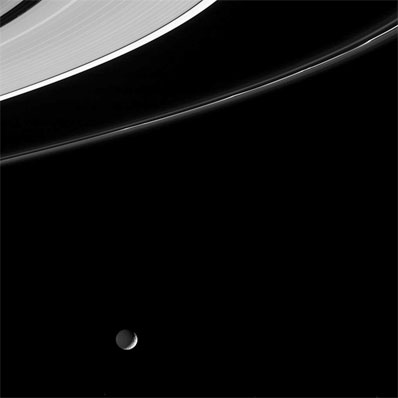
Outsider moon

Reflected light from Saturn dimly illuminates the night side of the cratered moon Mimas in this Cassini image. Above, the outer edges of the planet's main rings show some interesting details. Mimas is 398 kilometers (247 miles) across.


Credit: NASA/JPL/Space Science Institute
Download larger image version here


Several thin ringlets comprising the F ring are nicely visible here, and the bright core of the ring displays a few twisted knots. Perhaps less noticeable are kinks in one of the thin ringlets of material visible within the Encke Gap near the upper left corner. The outer edge of the A ring appears notably brighter than the ring material on the other side of the narrow Keeler Gap. Finally, numerous gravitational resonances give the A ring a grooved or striped appearance in this view.

The image was taken in visible light with the Cassini spacecraft narrow angle camera on Jan. 17, 2005, at a distance of approximately 1.2 million kilometers (746,000 miles) from Saturn. The image scale is 7 kilometers (4 miles) per pixel.

The Cassini-Huygens mission is a cooperative project of NASA, the European Space Agency and the Italian Space Agency. The Jet Propulsion Laboratory, a division of the California Institute of Technology in Pasadena, manages the mission for NASA's Science Mission Directorate, Washington, D.C. The Cassini orbiter and its two onboard cameras were designed, developed and assembled at JPL. The imaging team is based at the Space Science Institute, Boulder, Colo.

A dead star seen snacking on shredded asteroid

For the last two years, astronomers have suspected that a nearby white dwarf star called GD 362 was "snacking" on a shredded asteroid. Now, an analysis of chemical "crumbs" in the star's atmosphere conducted by NASA's Spitzer Space Telescope has confirmed this suspicion.

"This is a really fascinating system, that could offer clues to what our solar system may look like in approximately five billion years when our Sun becomes a white dwarf," said Dr. Michael Jura, of the University of California at Los Angeles (UCLA).

White dwarfs are essentially the glowing embers of stars that were once like our Sun. Sun-like stars spend most of their lives producing energy by fusing hydrogen atoms into "heavier" helium atoms. Our Sun is currently doing this.

Once the Sun-like star runs out of hydrogen, helium atoms will fuse to produce other heavier elements like carbon, which will eventually sink to the star's core. Meanwhile, the heat released during this helium fusion is so strong that the will star expand and vaporize all dust, rocks and planets that orbit nearby. At this stage, the star is called a "red giant." Ultimately, the red giant will shed its external layers, exposing a dense, hot core about the size of Earth, known as a "white dwarf."

Closely orbiting planets, asteroids, and dust are not expected to survive the red-giant phase of a Sun-like star's life, so astronomers were shocked to find so much dust around the white dwarf GD 362. According to Jura, GD 362 has been a white dwarf for approximately 900 million years -- so surrounding dust should have already been destroyed. He also notes that astronomers were surprised to find chemical elements heavier than hydrogen and helium in GD 362's atmosphere, because these elements should have already sunk to the star's core. When an abundance of heavy elements were first found in GD 362's atmosphere in 2004, scientists were not sure where they came from.

An explanation came in 2005, when two teams of astronomers independently found evidence for dust orbiting GD 362. Both groups argued that the elements in the atmosphere came from orbiting dust particles that rained onto star, and was vaporized by the white dwarf's intense heat. However, astronomers did not know where the dust came from.

Some astronomers predicted that the dust circled the star similar to the way rings of debris orbit Saturn. They believed that the ring of dust around GD 362 came from a large asteroid that had wandered too close to the star, and was shredded by the white dwarf's gravity. Meanwhile, others suspected that dust grains floated into the system from outer space and got pulled into GD 362's atmosphere.

According to Jura, new observations from Spitzer provide direct evidence for the first scenario. He notes that the silicates (sand-like dust grains) in asteroids are very different from the silicates randomly floating around the universe. Using Spitzer's infrared spectrograph instrument, Jura's team determined that the silicates in GD 362's atmosphere resembled the sand-like grains found in asteroids.

With Spitzer's Multiband Imaging Photometer (MIPS) instrument, Jura's team also noticed that the dust disk surrounding GD 362 was confined, meaning they saw an end to the dust disk.

"If this dust was floating in from the interstellar medium [or outer space] and falling onto the star, then we would see a trail of dust leading beyond this star system -- the dust disk shouldn't end. In the Spitzer observations, we see that the dust is confined to a region close to the star," said Jura.

Jura's paper on this topic was has been accepted by the Astronomical Journal. Other authors of this work include Dr. Jay Farihi, of the Gemini Observatory, Hawaii; and Drs. Ben Zuckerman and Eric Becklin, also of UCLA. Becklin led the Gemini North observations that first discovered dust in GD 362's atmosphere.

Orbiter images suggest possible caves on Mars

Northern Arizona University researchers Glen Cushing and Jut Wynne, working at the U.S. Geological Survey, propose that photos from the Mars Odyssey mission reveal football-field size holes that could be entrances to caves.

"If there is life on Mars, there is a good chance you'd find it in caves," said Wynne, an NAU graduate student in biological sciences and project leader for the USGS Earth-Mars Cave Detection Program.

He said the possible discovery could lead to more focused Mars explorations.


Researchers propose these images of seven black spots near a massive Martian volcano may actually be caves rather than impact craters. The images were taken from the Thermal Emission Imaging System aboard NASA's Mars Odyssey orbiter.

Martian caves are considered the "best potential havens for life" because they would be protected from surface radiation and other factors, he said.

"The Martian surface is an extremely harsh environment, so the significance of caves is in their protective nature," said Cushing, a graduate teaching assistant in NAU's Department of Physics and Astronomy, who was the first to spot the black areas on the photographs. "Caves on Mars could become habitats for future explorers, or could be the only structures that preserve evidence of past or present microbial life."

Cushing and Wynne, along with Tim Titus, an astrophysicist with USGS, and Phil Christensen, the chief scientist for the NASA imaging instrument and a researcher from Arizona State University, recently submitted their findings in a research paper at the 38th Lunar and Planetary Science Conference.

"We're suggesting that the seven black spots are skylights to areas where the surface may have collapsed into a chamber below," Wynne said. "Preserved evidence of past life on Mars might only be found in caves, and such discovery would be of unparalleled significance."

The claim for caves is based on an analysis of photographs from the Thermal Emission Imaging System aboard NASA's Mars Odyssey orbiter, which revealed seven black spots near a massive Martian volcano, Arsia Mons. Although this area of Mars is known for geological occurrences, the researchers said the dark spots do not look like impact craters because they don't have raised rims or blast patterns.

"This is a very interesting discovery with positive implications," said Nadine Barlow, an associate professor in physics and astronomy at NAU and expert on Martian impact craters. "Caves on Mars could be good places for long-term ice accumulation and that would make them ideal locations to look for life on Mars as well as valuable reservoirs for water to support future human exploration of the planet."

The Earth-Mars Cave Detection Program's overall objective is to develop techniques for systemically detecting caves on Earth in the thermal infrared and then applying these techniques to searching for caves on Mars, Wynne explained.

The team reported possible caverns ranging from 330 to 825 feet wide and 425 feet deep They've been named after loved ones of the researchers: Dena, Chloe, Wendy, Annie, Abbey, Nikki and Jeanne.

Christensen said the first avenue for further observations could be provided by NASA's latest Red Planet probe, the Mars Reconnaissance Orbiter.

"The spacecraft's high-resolution camera could take a closer look at the seven sisters‹including sidelong glances that might show whether the features open up into wider chambers beneath," Christensen said.

Sunday, April 22, 2007

European spacecraft tracking turbulence at Venus

New images and data from the European Space Agency's mission to Venus provide new insights into the turbulent and noxious atmosphere of Earth's sister planet. What causes violent winds and turbulences? Is the surface topography playing a role in the complex global dynamics of the atmosphere? Venus Express is on the case.


Four different views of the Venusian cloud system are seen here from Venus Express. The grey-scale of the images is such that black means more transparency, therefore less clouds, while white means more opacity, therefore more cloud concentration. Credits: ESA/VIRTIS/INAF-IASF/Obs. de Paris-LESIA

Venus' atmosphere represents a true puzzle for scientists. Winds are so powerful and fast that they circumnavigate the planet in only four Earth days - the atmospheric 'super-rotation' - while the planet itself is very slow in comparison, taking 243 Earth days to perform one full rotation around its axis.

At the poles things get really complicated with huge double-eyed vortices providing a truly dramatic view. In addition, a layer of dense clouds covers the whole planet as a thick curtain, preventing observers using conventional optical means from seeing what lies beneath.

Venus Express is on the contrary capable of looking through the atmosphere at different depths, by probing it at different infrared wavelengths. The Ultraviolet, Visible and Near-Infrared Mapping Spectrometer (VIRTIS) on board is continuing its systematic investigation of Venus' atmospheric layers to solve the riddle of the causes for such turbulent and stormy atmosphere.

The images presented with this article focus on Venusian atmospheric turbulences and cloud features, whose shape and size vary with planetary latitudes. At the equator, clouds are irregular and assume a peculiar 'bubble'-shape. At mid latitudes they are more regular and streaky, running almost parallel to the direction of the super rotation with speed reaching more than 400 kilometres per hour. Going higher up in latitude, in the polar region, the clouds end up in entering a vortex shape.

With its multi-wavelength eyes, VIRTIS can observe the atmosphere and the cloud layers not only at different depths, but also both in the day- and night-side of the planet - a characteristic that allows an overall assessment of the 'environmental' causes that can be at the origin of such an atmospheric complexity.

At the equator, the extremely violent winds of the super-rotation are in constant 'battle' with other kinds of local turbulences, or 'regional' winds, creating very complex cloud structures.

One type of regional wind is due to the strong flux of radiation from the Sun reaching the atmosphere of the planet on the day-side. This flux heats up the atmosphere creating convective cells, where masses of warm air move upwards and generate local turbulence and winds.

On the night-side there is obviously no flux from the Sun, but the clouds' shape and the wind dynamics are somehow similar to that we see on the day-side. So, scientists are currently trying to understand if there is any mechanism other than 'convection' responsible for the equatorial turbulences, both on the day- and night-side of Venus.

For instance, VIRTIS imaged clouds over Alpha Regio, an area close to the equator. This area is characterised by a series of troughs, ridges, and faults that are oriented in many directions, with surface features that can be up to 4 kilometres high. There might be a connection between the surface topography and the local atmospheric turbulence which is observed in this area. This and other hypotheses are being investigated by the Venus Express science teams using data from several instruments.

Actually, the Venusian topography may play an important role also in the global atmospheric dynamics. Understanding this surface-atmosphere connection is one of the major objectives of Venus Express - something to be verified in the whole course of the mission.

Star burps, then explodes

BERKELEY - Tens of millions of years ago, in a galaxy far, far away, a massive star suffered a nasty double whammy.

Signs of the first shock reached Earth on Oct. 20, 2004, when the star was observed letting loose an outburst so enormous and bright that Japanese amateur astronomer Koichi Itagaki initially mistook it for a supernova. The star survived for nearly two years, however, until on Oct. 11, 2006, professional and amateur astronomers witnessed it blowing itself to smithereens as Supernova (SN) 2006jc.

"We have never observed a stellar outburst and then later seen the star explode," said University of California, Berkeley, astronomer Ryan Foley. His group studied the 2006 event with ground-based telescopes, including the 10-meter (32.8-foot) W. M. Keck telescopes in Hawaii. Narrow helium spectral lines showed that the supernova's blast wave ran into a slow-moving shell of material, presumably the progenitor's outer layers that were ejected just two years earlier. If the spectral lines had been caused by the supernova's fast-moving blast wave, the lines would have been much broader.

Another group, led by Stefan Immler of NASA's Goddard Space Flight Center in Greenbelt, Md., monitored SN 2006jc with NASA's Swift satellite and the Chandra X-ray Observatory. By observing how the supernova brightened in X-rays, a result of the blast wave slamming into the outburst ejecta, they could measure the amount of gas blown off in the 2004 outburst: about 0.01 solar mass, the equivalent of about 10 Jupiters.

"The beautiful aspect of our SN 2006jc observations is that although they were obtained in different parts of the electromagnetic spectrum, in the optical and in X-rays, they lead to the same conclusions," said Immler.

"This event was a complete surprise," added Alex Filippenko, leader of the UC Berkeley/Keck supernova group and a member of NASA's Swift satellite team. "It opens up a fascinating new window on how some kinds of stars die."

All the observations suggest that the supernova's blast wave took only a few weeks to reach the shell of material ejected two years earlier, which did not have time to drift very far from the star. As the wave smashed into the ejecta, it heated the gas to millions of degrees, hot enough to emit copious X-rays. The Swift satellite saw the supernova continue to brighten in X-rays for 100 days, something that has never been seen before in a supernova. All supernovae previously observed in X-rays have started off bright and then quickly faded to invisibility.

"You don't need a lot of mass in the ejecta to produce a lot of X-rays," noted Immler. Swift's ability to monitor the supernova's X-ray rise and decline over six months was crucial to the mass determination by Immler's team. But he added that Chandra's sharp resolution enabled his group to resolve the supernova from a bright X-ray source that appears in the field of view of Swift's X-ray telescope.

"We could not have made this measurement without Chandra," said Immler, who will submit his team's paper next week to the Astrophysical Journal. "The synergy between Swift's fast response and its ability to observe a supernova every day for a long period, and Chandra's high spatial resolution, is leading to a lot of interesting results."

Foley and his colleagues, whose paper appears in the March 10 Astrophysical Journal Letters, propose that the star recently transitioned from a Luminous Blue Variable (LBV) star to a Wolf-Rayet star. An LBV is a massive star in a brief but unstable phase of stellar evolution. Similar to the 2004 eruption, LBVs are prone to blow off large amounts of mass in outbursts so extreme that they are frequently mistaken for supernovae, events dubbed "supernova impostors." Wolf-Rayet stars are hot, highly evolved stars that have shed their outer envelopes.

Most astronomers did not expect that a massive star would explode so soon after a major outburst, or that a Wolf-Rayet star would produce such a luminous eruption, so SN 2006jc represents a puzzle for theorists.

"It challenges some aspects of our current model of stellar evolution," said Foley. "We really don't know what caused this star to have such a large eruption so soon before it went supernova."

"SN 2006jc provides us with an important clue that LBV-style eruptions may be related to the deaths of massive stars, perhaps more closely than we used to think," added coauthor and UC Berkeley astronomer Nathan Smith. "The fact that we have no well-established theory for what actually causes these outbursts is the elephant in the living room that nobody is talking about."

SN 2006jc occurred in galaxy UGC 4904, located 77 million light years from Earth in the constellation Lynx. The supernova explosion, a peculiar variant of a Type Ib, was first sighted by Itagaki, American amateur astronomer Tim Puckett and Italian amateur astronomer Roberto Gorelli.

Beauty of barred spiral galaxy shown by Hubble

The NASA/ESA Hubble Space Telescope has delivered an unrivalled snapshot of the nearby barred spiral galaxy NGC 1672. This remarkable image provides a high definition view of the galaxy's large bar, its fields of star-forming clouds and dark bands of interstellar dust.


Credit: NASA, ESA, and The Hubble Heritage Team (STScI/AURA)-ESA/Hubble Collaboration
Download larger image version here


NGC 1672, visible from the Southern Hemisphere, is seen almost face on and shows regions of intense star formation. The greatest concentrations of star formation are found in the so-called starburst regions near the ends of the galaxy's strong galactic bar. NGC 1672 is a prototypical barred spiral galaxy and differs from normal spiral galaxies in that the spiral arms do not twist all the way into the centre. Instead, they are attached to the two ends of a straight bar of stars enclosing the nucleus.

Astronomers believe that barred spirals have a unique mechanism that channels gas from the disk inwards towards the nucleus. This allows the bar portion of the galaxy to serve as an area of new star generation. It appears that the bars are short-lived, begging the question: will non-barred galaxies develop a bar in the future, or have they already hosted one that has disappeared?

In the new image from the NASA/ESA Hubble Space Telescope, clusters of hot young blue stars form along the spiral arms, and ionize surrounding clouds of hydrogen gas that glow red. Delicate curtains of dust partially obscure and redden the light of the stars behind them. NGC 1672's symmetric look is emphasised by the four principal arms, edged by eye-catching dust lanes that extend out from the centre.

Galaxies lying behind NGC 1672 give the illusion they are embedded in the foreground galaxy, even though they are really much farther away. They also appear reddened as they shine through NGC 1672's dust. A few bright foreground stars inside our own Milky Way Galaxy appear in the image as bright, diamond-like objects.

NGC 1672 is a member of the family of Seyfert galaxies, named after the astronomer, Carl Keenan Seyfert, who studied a family of galaxies with active nuclei extensively in the 1940s. The energy output of these nuclei can sometimes outshine their host galaxies. The active galaxy family include the exotically named quasars and blazars. Although each type has distinctive characteristics, they are thought to be all driven by the same engine - supermassive black holes - but are viewed from different angles.

The new Hubble observations, performed with the Advanced Camera for Surveys aboard the observatory, have shed light on the process of starburst activity and on why some galaxies are ablaze with extremely active star formation.

NGC 1672 is more than 60 million light-years away in the direction of the Southern constellation of Dorado. These observations of NGC 1672 were taken with Hubble's Advanced Camera for Surveys in August of 2005. This composite image contains filters that isolate light from the blue, green, and infrared portions of the spectrum, as well as emission from ionized hydrogen.

The Hubble Space Telescope is a project of international cooperation between ESA and NASA.

Future space telescopes could detect Earth twin

For the first time ever, NASA researchers have successfully demonstrated in the laboratory that a space telescope rigged with special masks and mirrors could snap a photo of an Earth-like planet orbiting a nearby star. This accomplishment marks a dramatic step forward for missions like the proposed Terrestrial Planet Finder, designed to hunt for an Earth twin that might harbor life.


Three simulated planets -- one as bright as Jupiter, one half as bright as Jupiter and one as faint as Earth -- stand out plainly in this image created from a sequence of 480 images captured by the High Contrast Imaging Testbed at JPL. The asterisk marks the location of the system's simulated star. Credit: NASA/JPL-Caltech

Trying to image an exoplanet - a planet orbiting a star other than the sun - is a daunting task, because its relatively dim glow is easily overpowered by the intense glare of its much bigger, brighter parent star. The challenge has been compared to looking for a firefly next to a searchlight.

Now, two researchers at NASA's Jet Propulsion Laboratory in Pasadena, Calif., have shown that a fairly simple coronagraph - an instrument used to "mask" a star's glare - paired with an adjustable mirror, could enable a space telescope to image a distant planet 10 billion times fainter than its central star.

"Our experiment demonstrates the suppression of glare extremely close to a star, clearing a field dark enough to allow us to see an Earth twin. This is at least a thousand times better than anything demonstrated previously," said John Trauger, lead author of a paper appearing in the April 12 issue of Nature. This paper describes the system, called the High Contrast Imaging Testbed, and how the technique could be used with a telescope in space to see exoplanets. The lab experiment used a laser as a simulated star, with fainter copies of the star serving as "planets."

To date, scientists have used various techniques to detect more than 200 exoplanets. Most of these exoplanets are from five to 4,000 times more massive than Earth, and are either too hot, too cold or too much of a giant gas ball to be considered likely habitats for life. So far, no one has managed to capture an image of an exoplanetary system that resembles our own solar system. Scientists are eager to take a closer look at nearby systems, to hunt for and then characterize any Earth-like planets - those with the right size, orbit and other traits considered friendly for life.

In the lab demonstration, the High Contrast and Imaging Testbed overcame two significant hurdles that all telescopes face when trying to image exoplanets - diffracted and scattered light.

When starlight hits the edge of a telescope's primary mirror, it becomes slightly disturbed, producing a pattern of rings or spikes surrounding the major source of light in the focused image. This diffracted light can completely obscure any planets in the field of view.

To address this problem, Trauger and his colleagues at JPL fashioned a pair of masks for their system. The first, which resembles a blurry barcode, directly blocks most of the starlight, while the second clears away the diffracted rings and spikes. The combination creates enough darkness to allow the light of any planets to shine through.

"Mathematically, and sort of magically, this coronagraph blocks both the central star and its rings," said Wesley Traub of JPL, co-author of the new paper and Terrestrial Planet Finder project scientist.

Scattered light presents the additional hurdle. Minor ripples on a telescope's mirror produce "speckles" - faint copies of a star, shifted to the side, which can also hide planets. In the High Contrast Imaging Testbed, a deformable mirror the size of a large coin limits scattered light. With a surface that can be altered ever so slightly by computer-controlled actuators, this mirror compensates for the effects of minor imperfections in the telescope and instrument.

"This result is important because it points the way to building a space telescope with the ability to detect and characterize Earth-like planets around nearby stars," Traub said.

For their next steps, Trauger and Traub plan to improve the suppression of speckles by a factor of 10, and extend the method to accommodate many wavelengths of light simultaneously.

JPL manages the Terrestrial Planet Finder mission for NASA's Science Mission Directorate, Washington. JPL is a division of the California Institute of Technology in Pasadena.

Searching for the grandest asteroid tour

Asteroids are Earth's closest celestial neighbors, sometimes passing closer to Earth than even the Moon. And yet, to date, only two spacecraft have ever remained in proximity to one of these bodies. Last month, orbit mechanics experts from around the world met to discuss methods for finding the best possible spacecraft trajectory, or flight path, for visiting a sequence of asteroids. The gathering was part of the second Global Trajectory Optimisation Competition, organized by JPL.


Ida and its small satellite Dactyl are main belt asteroids located between Mars and Jupiter. Credit: NASA/JPL

The idea of an asteroid grand tour is a celestial analogue to the Grand Tour embarked upon by Renaissance travelers seeking to further their cultural knowledge of Europe. Just as the traveler had to judge carefully which cities to visit based on his or her available resources, so must designers of a spacecraft flight path contend with limited resources and constraints. Such restrictions include the rocket's ability to launch the spacecraft into space, the strength of the spacecraft's thruster, orbital positions of the various asteroids over time, and the spacecraft's longevity.

Determining the best possible trajectory within these constraints, out of the many good ones, is not a trivial matter. It requires a big-picture, or global, view of all the possibilities, that is, it requires global optimization. There are many possible approaches, each with its own strengths and weaknesses.

The inspiration for this problem was the need to study closely different types of asteroids. By visiting a member of each of four different asteroid groups, a spacecraft would provide insights into their chemical composition, their structural characteristics, how they formed, and which might be suitable for future space mining operations. Such insights would also be critical should the need ever arise to deflect an asteroid that is found to be on an Earth-threatening trajectory.

The problem posed by JPL's Outer Planets Mission Analysis Group for the second competition was to design a flight path for visiting four asteroids -- one from each group -- in the shortest amount of flight time and with the least amount of propellant. With almost 1,000 asteroids to choose from, more than 41 billion asteroid sequences could be considered. That's far too many to study individually in the short time allocated for the competition, even with the fastest computers, largest computer clusters and best algorithms.

Fourteen teams -- from Europe, Russia, China and the U.S. -- sought the elusive best possible trajectory. Their search took place over a period of four weeks late last year, at the end of which they submitted their top solution to be ranked against those of the other teams.

The winning trajectory was found by a team from the Polytechnic of Turin, Italy. Two professors, Lorenzo Casalino and Guido Colasurdo, along with Ph.D. student Matteo Rosa Sentinella and graduate student Francesco Cacciatore, successfully and quickly screened out billions of possible asteroid sequences to focus on the most practical ones. Their winning trajectory, involving visits of four different asteroids in just over nine years, was followed by trajectories from a Russian team (the Moscow Aviation Institute and the Khrunichev State Research and Production Space Center), and a team from the European Space Agency's Advanced Concepts Team.

The workshop where the various teams convened for their discussions took place in Sedona, Ariz., in conjunction with the Space Flight Mechanics Meeting of the American Astronautical Society and the American Institute of Aeronautics and Astronautics.

Did the competition yield the best possible trajectory? With such complexity, it is likely impossible to say, but an educated guess, and the insights gained by comparing the various teams' methods, would suggest that there is still some room for improvement. The Turin team, as winners of this year's competition, will now be organizing the Third Global Trajectory Optimisation Competition, where various teams will again have the opportunity to test their mettle in solving the most challenging problems currently faced by spacecraft trajectory designers.

The Global Trajectory Optimisation Competition was instituted in 2005 by Dario Izzo of the European Space Agency's Advanced Concepts Team. As winners of the first competition, the JPL team organized this latest one, with support from NASA's In-Space Propulsion Program.

Saturday, April 21, 2007

One year at Venus, and orbiter still going strong

One year has passed since Venus Express, Europe's first mission to Venus and the only spacecraft now in orbit around the planet, reached its destination. Since then, this advanced probe, born to explore one of the most mysterious planetary bodies in the Solar System, has been revealing planetary details never caught before.


Both panels of this false-colour view show the oxygen airglow in the night-side atmosphere of Venus. Credits: ESA/VIRTIS/INAF-IASF/Obs. de Paris-LESIA

Intensively visited by several Russian and American probes from the 60s to the early 90s, Venus has always represented a puzzling target for scientists worldwide to observe. Venus Express, designed and built in record time by ESA, was conceived with the purpose of studying Venus - unvisited since 1994 - in the most comprehensive and systematic way ever, to provide a long-due tribute to a planet so interesting, yet cryptic.

Using state-of-the-art instrumentation, Venus Express is approaching the study of Venus on a global scale. The space probe is collecting information about Venus' noxious and restless atmosphere (including its clouds and high-speed winds, as seen from this video obtained with the VMC camera on board) and its interaction with the solar wind and the interplanetary environment. Last but not least, it is looking for signs of surface activity, such as active volcanism.

"During one year of observations, we have already collected huge amount of data, which is exactly what we need to decode the secrets of an atmosphere as complex as that of Venus," said Hakan Svedhem, Venus Express Project Scientist at ESA. "Analysing it is an extreme effort for all science teams, but it is definitively paying back in terms of results."

The first ever, terrific global views of the double-eyed vortex at Venus' south pole, the first sets of 3D data about the structure and the dynamics of the sulphuric-acid clouds surrounding the planet in a thick curtain, temperature maps of the surface and the atmosphere at different altitudes, are only a few of the results obtained so far.

"Continuing at today's rate, and on the basis of what we were able to see so far, there is no doubt that Venus Express will eventually allow a better global understanding of this planet," continued Svedhem. "Not only will planetary science in general benefit from this, but also understanding Venus - its climate and atmospheric dynamics - will provide a better comprehension of the mechanisms that drive long-term climate evolution on our own Earth."

The night-glowing 'lantern' of Venus

New infrared data is now available about Venus' oxygen airglow - a phenomenon detectable on the night-side that makes the planet glow like a 'space lantern'.

"The oxygen airglow was first discovered thanks to ground observations, and also observed by other missions to Venus such as the Russian Venera spacecraft and the US Pioneer Venus orbiter," said Pierre Drossart, co-Principal Investigator on Venus Express' VIRTIS instrument. "However, the global and detailed view we are getting thanks to Venus Express is truly unprecedented."


This grey-scale image shows the oxygen airglow in the night-side of Venus, appearing as the bright features similar to 'clouds' visible at the bottom of the image, and also visible as the white ring surrounding the planet's disk (limb). Credits: ESA/VIRTIS/INAF-IASF/Obs. de Paris-LESIA

The fluorescence of the airglow is produced when oxygen atoms present in the atmosphere 'recombine' into molecular oxygen (or 'O2') emitting light. Where does the oxygen come from?

"The oxygen in the atmosphere of Venus is a very rare element," continued Drossart. At high altitudes in the atmosphere, on the day-side of Venus, the strong flux of ultraviolet radiation coming from the Sun 'breaks' the molecules of carbon dioxide ('CO2') present in large quantity in the atmosphere, liberating oxygen atoms. "These atoms are then transported by the so-called 'sub-solar' and 'anti-solar' atmospheric circulation towards the night side of the planet. Here the atoms migrate from the high atmosphere to a lower layer, called 'mesosphere', where they recombine into O2. By doing this, they emit light at specific wavelengths that can be observed through remote sensing from Earth and with Venus Express," added Drossart.

The detection of the airglow, and the capability to follow its evolution in time, is extremely important for several reasons.

"First, we can use the distribution and motion of these fluorescent O2 'clouds' to understand how the atmospheric layers below move and behave," said Giuseppe Piccioni, the other co-Principal Investigator on VIRTIS. "In this sense, the O2 airglow is a real 'tracer' of the atmospheric dynamics on Venus."

"Second, the analysis of this phenomenon will provide new clues on how its global atmospheric chemistry works - a very challenging task indeed, and still an open field of research," continued Piccioni. "By calculating the speed at which this chemical 'recombination' takes place, we might be able - in the future - to understand if there are mechanisms that favour, or catalyze, this recombination, and learn more about the production and recombination of the other chemical species in the Venusian atmosphere."

"Third, the observation of the oxygen airglow also allows to a better understanding of the global 'energetic' exchange between Venus's mesosphere - at upper boundary of which the airglow is situated, with Venus' thermosphere, an even higher layer directly influenced by the Sun."

Notes for editors

The mechanism for the production of the airglow was described in 1979 by P.Connes, after its emission was discovered through ground-based observations.

Venus Express was launched on 9 November 2005 from the Baikonur cosmodrome in Kazakhstan on board a Starsem Soyuz-Fregat rocket. It reached Venus about five months later, on 11 April 2006, when a delicate manoeuvre injected it into orbit around the planet. After a period of commissioning the spacecraft and the instruments, Venus Express started its nominal science operations on 4 July 2006.


This image provides a schematic view of the oxygen airglow production in the atmosphere of Venus. Credits: R. Hueso, Grupo de Ciencias Planetarias, Univ. del País Vasco, Spain

Was Einstein right? First look at Gravity Probe B results


An artist's concept of the Gravity Probe-B spacecraft. Credit: NASA/Stanford University

For the past three years a satellite has circled the Earth, collecting data to determine whether two predictions of Albert Einstein's general theory of relativity are correct. Over the weekend, at the American Physical Society (APS) meeting in Jacksonville, Fla., Professor Francis Everitt, a Stanford University physicist and principal investigator of the Gravity Probe B (GP-B) Relativity Mission, a collaboration of Stanford, NASA and Lockheed Martin, provided the first public peek at data that will reveal whether Einstein's theory has been confirmed by the most sophisticated orbiting laboratory ever created.

"Gravity Probe B has been a great scientific adventure for all of us, and we are grateful to NASA for its long history of support," Everitt said. "My colleagues and I will be presenting the first results (Saturday and Sunday). It's fascinating to be able to watch the Einstein warping of space-time directly in the tilting of these GP-B gyroscopes-more than a million times better than the best inertial navigation gyroscopes."

The GP-B satellite was launched in April 2004. It collected more than a year's worth of data that the Stanford GP-B science team has been pouring over for the past 18 months. The satellite was designed as a pristine, space-borne laboratory, whose sole task was to use four ultra-precise gyroscopes to measure directly two effects predicted by general relativity. One is the geodetic effect-the amount by which the mass of the Earth warps the local space-time in which it resides. The other effect, called frame-dragging, is the amount by which the rotating Earth drags local space-time around with it. According to Einstein's theory, over the course of a year, the geodetic warping of Earth's local space-time causes the spin axes of each gyroscope to shift from its initial alignment by a minuscule angle of 6.606 arc-seconds (0.0018 degrees) in the plane of the spacecraft's orbit. Likewise, the twisting of Earth's local space-time causes the spin axis to shift by an even smaller angle of 0.039 arc-seconds (0.000011 degrees)-about the width of a human hair viewed from a quarter mile away-in the plane of the Earth's equator.

GP-B scientists expect to announce the final results of the experiment in December 2007, following eight months of further data analysis and refinement. Saturday, Everitt and his team shared what they have found so far-namely that the data from the GP-B gyroscopes clearly confirm Einstein's predicted geodetic effect to a precision of better than 1 percent. However, the frame-dragging effect is 170 times smaller than the geodetic effect, and Stanford scientists are still extracting its signature from the spacecraft data. The GP-B instrument has ample resolution to measure the frame-dragging effect precisely, but the team has discovered small torque and sensor effects that must be accurately modeled and removed from the result.

"We anticipate that it will take about eight more months of detailed data analysis to realize the full accuracy of the instrument and to reduce the measurement uncertainty from the 0.1 to 0.05 arc-seconds per year that we've achieved to date down to the expected final accuracy of better than 0.005 arc-seconds per year," said William Bencze, GP-B program manager. "Understanding the details of this science data is a bit like an archeological dig. A scientist starts with a bulldozer, follows with a shovel, and then finally uses dental picks and toothbrushes to clear the dust away from the treasure. We are passing out the toothbrushes now."

The two discoveries

Two important discoveries were made while analyzing the gyroscope data from the spacecraft: one, the "polhode" motion of the gyroscopes dampens over time; two, the spin axes of the gyroscopes were affected by small classical torques. Both of these discoveries are symptoms of a single underlying cause: electrostatic patches on the surface of the rotor and housing. Patch effects in metal surfaces are well known in physics and were carefully studied by the GP-B team during the design of the experiment to limit their effects. Though previously understood to be microscopic surface phenomena that would average to zero, the GP-B rotors show patches of sufficient size to measurably affect the gyroscopes' spins.

The gyroscope's polhode motion is akin to the common "wobble" seen on a poorly thrown American football, though it shows up in a much different form for the ultra-spherical GP-B gyroscopes. While it was expected that this wobble would exhibit a constant pattern over the mission, it was found to slowly change due to minute energy dissipation from interactions of the rotor and housing electrostatic patches. The polhode wobble complicates the measurement of the relativity effects by putting a time-varying wobble signal into the data.

The electrostatic patches also cause small torques on the gyroscopes, particularly when the space vehicle axis of symmetry is not aligned with the gyroscope spin axes. Torques cause the spin axes of the gyroscopes to change orientation, and in certain circumstances, this effect can look like the relativity signal GP-B measures. Fortunately, the drifts due to these torques have a precise geometrical relationship to the misalignment of the gyro spin/vehicle symmetry axis and can be removed from the data without directly affecting the relativity measurement.

Both of these discoveries first had to be investigated, precisely modeled and carefully checked against the experimental data before they could be removed as sources of error. These additional investigations have added more than a year to the data analysis, and this work is still in process. To date, the team has made very good progress in this regard, according to its independent Science Advisory Committee, chaired by relativistic physicist Clifford Will of Washington University in St. Louis, Mo., that has been monitoring every aspect of GP-B for the past decade.

In addition to providing a first peek at the experimental results at the APS meeting, the GP-B team has released an archive of the raw experimental data. The data will be available through the National Space Sciences Data Center at the NASA Goddard Space Flight Center beginning in June.

Conceived by Stanford Professors Leonard Schiff, William Fairbank and Robert Cannon in 1959 and funded by NASA in 1964, GP-B is the longest running, continuous physics research program at both Stanford and NASA. While the experiment is simple in concept-it utilizes a star, a telescope and a spinning sphere-it took more than four decades and $760 million to design and produce all the cutting-edge technologies necessary to bring the GP-B satellite to the launch pad, carry out this "simple" experiment and analyze the data. On April 20, 2004, GP-B made history with a perfect launch from Vandenberg Air Force Base in California. After a four-month initialization and on-orbit check-out period, during which the four gyroscopes were spun up to an average of 4,000 rpm and the spacecraft and gyro spin axes were aligned with the guide star, IM Pegasi, the experiment commenced. For 50 weeks, from August 2004 to August 2005, the spacecraft transmitted more than a terabyte of experimental data to the GP-B Mission Operations Center at Stanford. One of the most sophisticated satellites ever launched, the GP-B spacecraft performed magnificently throughout this period, as did the GP-B Mission Operations team, comprised of scientists and engineers from Stanford, NASA and Lockheed Martin, said Stanford Professor Emeritus Bradford Parkinson, a co-principal investigator with John Turneaure and Daniel DeBra, also emeritus professors at Stanford. The data collection ended on Sept. 29, 2005, when the helium in spacecraft's dewar was finally exhausted. At that time, the GP-B team transitioned from mission operations to data analysis.

Over its 47-year lifetime, GP-B has advanced the frontiers of knowledge, provided a training ground for 79 doctoral students at Stanford (and 13 at other universities), 15 master's-degree students, hundreds of undergraduates and dozens of high school students who worked on the project. In addition, GP-B spawned more than a dozen new technologies, including the record-setting gyroscopes and gyro suspension system, the SQUID (for Superconducting QUantum Interference Device) gyro readout system, the ultra-precise star-pointing telescope, the cryogenic dewar and porous plug, the micro-thrusters and drag-free technology, and the Global Positioning System-based orbit determination system. All of these technologies were essential for carrying out the experiment, but none existed in 1959 when the experiment was conceived. Furthermore, some technologies that were designed at Stanford for use in GP-B, such as the porous plug that controlled the escape of helium gas from the dewar, enabled and were used in other NASA experiments such as COBE (the COsmic Background Explorer, which won this year's Nobel prize) WMAP (for Wilkinson Microwave Anisotropy Probe) and the Spitzer Space Telescope.

The experiment's final result is expected upon completion of the data analysis this December. Asked for his final comment, Everitt said: "Always be suspicious of the news you want to hear."

The missing link


This artist's impression shows the "super-aurorae" present at the magnetic poles of brown dwarfs, where the extremely bright beams of radiation originate. These beams sweep Earth once each time the dwarf rotates, producing periodic pulses. Hallinan et al./NRAO/AUI/NSF

April 19, 2007
Brown dwarfs, thought just a few years ago to be incapable of emitting any significant amounts of radio waves, have been discovered putting out extremely bright "lighthouse beams" of radio waves, much like pulsars. A team of astronomers made the discovery using the National Science Foundation's Very Large Array (VLA) radio telescope.

"These beams rotate with the brown dwarf, and we see them when the beam passes over the Earth. This is the same way we see pulses from pulsars," said Gregg Hallinan of the National University of Ireland, Galway. "We now think brown dwarfs may be a missing link between pulsars and planets in our own Solar System, which also emit, but more weakly," he added.

Brown dwarfs are enigmatic objects that are too small to be stars but too large to be planets. They are sometimes called "failed stars" because they have too little mass to trigger hydrogen fusion reactions at their cores, the source of the energy output in larger stars. With roughly 15 to 80 times the mass of Jupiter, the largest planet in our Solar System, brown dwarfs were long thought to exist. However, it was not until 1995 that astronomers were able to actually find one. A few dozen are known today.

In 2001, a group of summer students at the National Radio Astronomy Observatory used the VLA to observe a brown dwarf, even though seasoned astronomers had told them that brown dwarfs were not observable at radio wavelengths. Their discovery of a strong flare of radio emission from the object surprised astronomers, and the students' scientific paper on the discovery was published in the prestigious scientific journal Nature.

Hallinan and his team observed a set of brown dwarfs with the VLA last year, and found that three of the objects emit extremely strong, repeating pulses of radio waves. They concluded that the pulses come from beams emitted from the magnetic poles of the brown dwarfs. This is similar to the beamed emission from pulsars, which are super dense neutron stars, and much more massive than brown dwarfs.

The characteristics of the beamed radio emission from the brown dwarfs suggest that it is produced by a mechanism also seen at work in planets, including Jupiter and Earth. This process involves electrons interacting with the planet's magnetic field to produce radio waves that are amplified by natural masers, the same way a laser amplifies light waves.

"The brown dwarfs we observed are between planets and pulsars in the strength of their radio emissions," said Aaron Golden, also of the National University of Ireland, Galway. "While we don't think the mechanism that's producing the radio waves in brown dwarfs is exactly the same as that producing pulsar radio emissions, we think there may be enough similarities that further study of brown dwarfs may help unlock some of the mysteries about how pulsars work," he said.

While pulsars were discovered 40 years ago, scientists still do not understand the details of how their strong radio emissions are produced.

The brown dwarfs rotate at a much more leisurely pace than pulsars. While pulsars rotate and produce observed pulses several times a second to hundreds of times a second, the brown dwarfs observed with the VLA are showing pulses roughly once every two to three hours.

Red supergiants let off steam

This image shows water vapor-clouds (in shades of blue) in S Persei, observed using MERLIN. The doppler shifts of the maser spectral lines mean astronomers can measure the speed and direction of the wind blown away from the star. RAS

April 17. 2007
Steamy clouds have been observed bubbling away from four massive stars known as red supergiants. A team from Jodrell Bank Observatory, using the MERLIN array and European and Global VLBI Networks, found that the stars are actually steaming as they enter their final death throes, driving out thick clouds of water vapor immersed in more tenuous gas.

Dr. Anita Richards, who will present today at the Royal Astronomical Society's National Astronomy Meeting in Preston, U.K. said, "Red supergiants lose more than half their mass before ending their lives as supernovae. Our observations show that this doesn't happen smoothly, like an onion shedding layers. We see water vapor clouds, which are over-dense and over-magnetized, are rapidly accelerating away from the star. They are embedded in a cooler, more diffuse gas producing distinctive emission from hydroxyl, a break-down product of water."

The group studied 'maser' emissions from the gas clouds surrounding the star: molecules in the gas amplify and emit beams of microwave radiation in much the same way as a laser produces very narrow, bright beams of light. Water emits at 1.3 cm wavelength, under hot, dense conditions (around 1000 kelvins). Hydroxyl emission at 18 cm can only occur from cooler, less dense gas, and it was very unexpected to detect it as close to two of the stars as the water masers. The only explanation seems to be that the water masers come from clumps where the gas density is, which is typically 50 times higher than the rest of the wind from the star. Supporting evidence comes from measurements of the magnetic field strength associated with the hydroxyl masers, which is much weaker than that of the adjacent water masers, as is expected if the hydroxyl environment is more diffuse.

In this image, the water-vapor clouds are shown in shades of red. The symbols show the positions of the hydroxl masers observed using MERLIN and VLBI, color-coded according to the velocity with respect to the star — blue is expanding toward us, and red away from us. RAS
The water vapor clouds appear to be very dusty and are accelerating faster than the surrounding gas. Only a few of these steam clouds form each stellar period of several years, filling just a few percent of the volume of the maser shell around the star, but they contain most of the mass lost by the star.

In the study, the maser emissions from the water vapor appeared to show that the clouds had a lifetime of only a few decades, although clouds were observed at distances that would have taken about a century to reach. The puzzle was solved by comparing the MERLIN results with long-term observations from the Puschino Radio Telescope in Russia, which revealed individual clouds winking off and back on again due to the fickle nature of maser excitation, or beaming. Richards said, "These observations are intriguing because, from the size of the masing shell, we estimate that the water vapor clouds take about 100 years to bubble away into interstellar space, but we can only actually 'see' any particular cloud for a few years."


For more info about the articles related visit:http://www.astronomy.com/asy/default.aspx?c=a&id=5443

If copyrights are violated,please contact swapnahelpu@gmail.com

National Dark-Sky Week

National Dark-Sky Week
Eastern seaboard at night: the white areas indicate sky glow from poor lighting. Poor lighting not only washes out the splendor of the heavens but also reduces visibility at night, wastes energy, and disturbs wildlife. The harmful effects of light pollution are far-reaching. NOAA and the US Air Force

April 16, 2007
Observance of the fifth annual National Dark-Sky Week will take place April 17–24. Founded in 2003 by Jennifer Barlow, the event highlights concern for increasing light pollution — the "glow" from outdoor lights that washes out the stars in the night sky. Endorsed by the International Dark-Sky Association, American Astronomical Society, and the Astronomical League, event participation grows each year as the public becomes more aware of light pollution and its effects on our everyday lives and the environment.

National Dark-Sky Week seeks to deter light pollution by encouraging better overall outdoor lighting practices. Simply turning off unnecessary lighting for one week is only a temporary solution. National Dark-Sky Week seeks to educate the public about lighting fixtures that help reduce light pollution by focusing light downward instead of up into the sky.

As cities continue to expand, so does light pollution through poor planning and misuse of outdoor lighting. While light pollution is detrimental to our ability to observe and enjoy the night sky, it also disrupts the surrounding natural environment, wastes energy, and has the potential to cause health problems. "The only way that National Dark-Sky Week can succeed is if more people participate every year," says Barlow. "No significant reduction in light pollution can be made unless a great number of people turn off their lights."

The campaign also encourages the public to attend area star parties or visit a local observatory. But always be careful not to turn out lights that are necessary for public safety, and when going stargazing, carry a red-tinted flashlight and stay in a large group.

"National Dark-Sky Week is a great opportunity to dust off the old telescope from the attic and share in the wonder of the universe that has been part of the human tradition for thousands of years," says Barlow.

Content source from:http://www.astronomy.com/asy/default.aspx?c=a&id=5440
For more details visit this site..
If copyrights are violated,please contact swapnahelpu@gmail.com

New nebula identified


Red Square
Using the Hale Telescope and Keck-2 Telescope, astronomers have identified a square-shaped nebula in a field of stars. Peter Tuthill/University of Sydney

April 13, 2007
Astronomers announced the arrival of a new member in the pantheon of exotically beautiful celestial objects. Christened the "Red Square" by Peter Tuthill, leader of the team, the image was compiled with data from the 200-inch Hale Telescope at Palomar Observatory, owned and operated by the California Institute of Technology, and the Keck-2 Telescope atop Mauna Kea, Hawaii.

The findings will appear April 13 in the journal Science in an article titled "A symmetric bipolar nebula around MWC 922," written by Tuthill from the University of Sydney and James Lloyd of Cornell University.

"Discoveries as beautiful — and interesting — as this one don't come around very often in astronomy." says Tuthill. "And it took some of the world's most advanced telescopes, together with a good dose of luck, to find this jewel hidden among the myriad stars in the galaxy."

"The key to finding it was in the revolutionary new imaging technology of adaptive optics, which acts like a myopia cure for a telescope," agrees Lloyd. "Startlingly clear images capable of revealing objects like this are now possible without the blurring."

The pair studied a hot star called MWC 922 in the constellation Serpens (the serpent mythologically associated with the origin of medicine). The image shown here combines data taken in near-infrared light (1.6 microns) and shows a region 30.8 arc seconds on a side around MWC 922. As the outer periphery of the nebula is very faint compared to the core, the image has been processed and sharpened to display the full panoply of detail and structure.

"The thing that really takes your breath away is the astonishing degree of symmetry within the intricate linear forms," says Tuthill. "If you fold things across the principle diagonal axis, you get an almost perfect reflection symmetry. This makes the Red Square nebula the most symmetrical object of comparable complexity ever imaged."

The overall architecture of twin opposed conical cavities (commonly known in astronomy as a "bipolar nebula") is seen to be adorned with a remarkable sequence of sharply defined linear rungs or bars. This series of rungs and conical surfaces lie nested, one within the next, down to the heart of the system, where the hyperbolic bicone surfaces are crossed by a dark lane running across the principle axis.

One particularly fascinating feature visible in the images is a series of faint radial spokes, like teeth of a comb, pointing away from the center. "Structures such as this are rarely seen in nebulae, and the high degree of regularity in this case may point to the intriguing possibility that these bands are shadows cast by periodic ripples or waves on the surface of an inner disk close to the star at the heart of the system," says Lloyd.

But the most compelling and important implication for astronomy comes from the three-dimensional structure implied by the Red Square images.

"If you can really get a mental grasp of the three-dimensional geometry implied by the Red Square images," says Tuthill, "then it is fascinating to take a second look at one of the most famous astronomical images of them all: SN1987A." An image of the supernova as seen by the Hubble Space Telescope is to the right, showing the beautiful and unexpected ring system revealed around SN1987A — the only naked-eye supernova since the discovery of the telescope.

"We are not saying that the star MWC 922 at the heart of the Red Square is about to explode as a supernova." says Lloyd, "But we're not ruling it out either, and if it did it would certainly put on quite a show as it kindles the outer reaches of its nebula."

Whatever the fate of the central star, the remarkable series of bars seen in the Red Square make it the best astrophysical laboratory yet discovered for studying the physics of generating the mysterious sharp polar-ring systems like that around SN1987A.

According to Tuthill, "This is just the beginning — a system as complex and fascinating as this is bound to keep us guessing for years to come."

Wednesday, April 18, 2007

If the Sun Stopped Shining Today, We Wouldn’t Know It for 6 Million Years

Remember that scene in Star Trek: Generations, where Malcolm McDowell’s character had access to this giant gun that would stop all fusion processes within a star, causing it to immediately go out? No? Well, umm, he did and uhhh (damn now I gotta explain the whole movie), so umm, let’s just say he was a bad guy trying to put out a bunch of stars that were in his way. He was Captain Kirk’s Dr. No.

Now just so you know, I’m not the physics-nerd-party-pooper-guy that goes to parties telling everyone why warp drive won’t work or that the holodeck is impossible for this or that physics-related reason, but, I’m sorry folks, it turns out things wouldn’t work out quite the way the movie would like. If such a gun did exist, Malcolm McDowell would have to wait around about 6 million years for anything to happen.

I can say that here though, because no matter how much I would wish it otherwise, this blog simply isn’t a party. It could also be argued that any party where the physics of Star Trek is a topic of discussion probably isn’t a babe-fest to begin with, but I digress.

Before I tell you why it would take so long, I have to confess that my title for this post is a little misleading. When I say stopped shining, I mean if the processes that caused the Sun to shine, nuclear fusion, suddenly stopped today, we wouldn’t notice it for another 6 million years. The Sun would still shine during that time.

But that title was way catchier than: If Nuclear Fusion Suddenly Stopped at the Core of the Sun, then blah,blah,blah…

OK, so here goes…


Nucleosynthesis In A StarStars, of which our Sun is one, shine by fusing Hydrogen atoms into Helium, Helium into heavier elements like Carbon, with each set of fusion processes producing heavier elements up to Iron. Iron can’t be fused in stars and so the chain stops there. It isn’t a neat progression for one element to the next, but the basic effect is that lighter elements fuse into the heavier elements and stop at Iron. A star with an Iron core is ready to die.

These fusion processes occur in the core of the star, with a minimum temperature of 5 million degrees to fuse Hydrogen, 100 million degrees to fuse Helium, 1 billion degrees to fuse Carbon and even higher temperatures to fuse heavier elements. When two atoms are fused together to make a heavier element, a large amount of energy in the form of photons of all wavelengths, from radio to x-rays, are emitted.

What’s really remarkable about this however, is that it takes that photon, once it’s released in the core, several million years to reach the surface of the star.

A photon emitted from the reactions in the core follow what is called a random walk toward the surface Here’s an analogy from this site.

You head off in one direction, get bounced in another direction, then still another, and so on. The problem is that, unlike the person in a subway station, the photons (particles of light) don’t know which way they want to go. They are jostled about in scattering collisions with particles (mostly electrons). It’s like being blindfolded in a crowded subway station. Eventually you will work your way to the door by chance and leave. But how many steps will it take you to go a certain distance?

For photons emitted in the cores of stars, the answer turns out to be millions of years. So, the light we’re seeing from the Sun today, was actually generated several million years (and eight minutes) ago.

Once the photons escape from the surface, it only takes them eight minutes to get to us traveling at the speed of light.

Just thought you might want to know in case you decided to build a gun like that for yourself.

Intelligent Extraterrestrial Beings Do Not Exist

2089 WebOne of the things I love to do is go through old volumes of astronomy journals and read articles that catch my eye. I know, how sad is that?

One of the really cool benefits of doing it though is that I can read over landmark papers first hand, it gives me a feeling of actually being there when important discoveries are being reported.

Earlier today, I was in the astrophysics library at the university and I happened upon a paper in 1980 by Frank Tipler, a proponent of the Anthropic Principle. The title of the paper is Extraterrestrial Intelligent Beings Do Not Exist.

This is not a landmark paper, but it does present an interesting case for the fact that there isn’t anyone out there. I don’t happen to agree with any of it, still it’s nice to get another viewpoint. I found it fascinating.

Essentially, Tipler took Carl Sagan and other proponents of the possibility of ET life head on. Tipler felt that the Anthropic principle (the idea that the universe is fine-tuned for us to exist) and intelligent ET life were unlikely to BOTH be correct, so he set out to prove that there couldn’t be any intelligent life elsewhere in the universe.

Basically, his idea centers on von Neumann machines. These are self-replicating, self-repairing machines that could be build to search for life in the galaxy. These very efficient machines would build copies of themselves at a faster and faster rate until every solar system in the galaxy had one.

An ET civilization could send out these probes, let them self-replicate, and then sit back and wait for the reports to come back. Tipler reasoned that if there were other civilizations, then EVENTUALLY these types of machines would get build by SOMEONE (oh, surely!). Once they were set out, it would take only about 300 million years to occupy every solar system in our galaxy.

Three hundred million years isn’t a very long time compared to the age of our galaxy, this should be plenty of time for these machines to have done their thing by now.

According to Tipler, since there isn’t one of these probes in our solar system (as far as we know), there isn’t any intelligent ET life ANYWHERE.

So there.

[By comparison, I’ve posted before about a study that was conducted using computer simulations and only eight probes. It would take half the age of the universe to only cover 4% of our galaxy searching for ET intelligence that way.]

Tipler had tried to get this paper published twice before, once to the journal Science, where it was sent to Carl Sagan for review because he was the leading expert in the field. Sagan rejected it. The second time it was submitted to Icarus, a journal (unfortunately for Tipler) edited by Carl Sagan at the time. To Sagan’s credit, he sent the paper out to independent reviewers who then rejected it. It was eventually published in the Quarterly Journal of the Royal Astronomical Society.

I know I’m a big nerd, but I recommend just searching through astronomical journals when you can. Most of this stuff is online through the Astrophysics Data System (ADS), an excellent resource. You’d be surprised at what you stumble across.

Save Our Skies! Participate in GLOBE at Night Project

BadlightWe are losing our night skies and from May 8 - 21 you can help do something about it.

Slowly but surely, the stars are fading from view. On average, when we look up at the sky on a clear, dark night, we can see only about 3000 stars and that number is getting smaller all the time.

The reasons are simple: we are flooding the sky with light. Light from buildings, houses, parking lots, etc are drowning out the stars and planets. Constellations are getting harder to find because not all of the stars are visible anymore and the Milky Way has all but vanished in urban areas.

This must stop. We are losing our connection to the stars, the universe.

Below is one of my favorite pictures ever taken by NASA:

Earth Lights Lrg
Image Credit: NASA Visible Earth

The above image is of a cloudless Earth taken at night. It was taken by satellites over the course of several months and all images with no clouds were pieced together. I have a framed version of this in my office.

While that image is quite beautiful, it’s also very distressing. Clearly visible are where the major technological areas of the planet are spewing light up into the sky. This image, taken 30 years from now, will look even worse if we don’t do something about it.

But, what can we do? I plan to write several posts on that very thing this week. Starting with this one.

GLOBE at Night

The very first thing I want to tell you about is GLOBE at Night. From March 8-21, people can look up into the sky and report what the skies look like in their area. This project is characterized as

an educational citizen-science program rather than a purely scientific campaign

But the organizers believe that the data collected will be useful scientifically.

What you have to do couldn’t be simpler. You look up, locate the constellation Orion and compare what you see with these magnitude charts, then you simply report what your observation. This is not as accurate as I’d like, but it’s certainly better than nothing and will provide some good estimates for the seeing conditions from all over the planet. I’m quite excited to see the results.

This is a great activity to do with your kids, take ‘em outside and have them make the measurement, there’s a family packet, a teacher packet as well as lots of great activities. If you’re a teacher or parent, this is a great time to do some real science as a family or class.

I urge all of you to participate. It’s simple and it gets you involved to help solve the serious problem of light pollution.

Taken from GLOBE at Night website:

  1. Find your latitude and longitude.
  2. Find Orion.
  3. Match your nighttime sky with one of our magnitude charts
  4. Report your observations
  5. Compare your observations to thousands around the world.

Everything is laid out clearly on the site, even people who’ve never really looked up before can make this observation. They have made it trivial.

I think this will provide an interesting glimpse into the changing skies around the world. I plan to make observations from several locations around Colorado. As it happens, a friend is coming to visit me over Spring Break and we will be traveling all over Colorado, I’ll submit observations from each place we visit.

Click here, go forth and save our skies.

Save Our Skies! Participate in GLOBE at Night Project

BadlightWe are losing our night skies and from March 8 - 21 you can help do something about it.

Slowly but surely, the stars are fading from view. On average, when we look up at the sky on a clear, dark night, we can see only about 3000 stars and that number is getting smaller all the time.

The reasons are simple: we are flooding the sky with light. Light from buildings, houses, parking lots, etc are drowning out the stars and planets. Constellations are getting harder to find because not all of the stars are visible anymore and the Milky Way has all but vanished in urban areas.

This must stop. We are losing our connection to the stars, the universe.

Below is one of my favorite pictures ever taken by NASA:

Earth Lights Lrg
Image Credit: NASA Visible Earth

The above image is of a cloudless Earth taken at night. It was taken by satellites over the course of several months and all images with no clouds were pieced together. I have a framed version of this in my office.

While that image is quite beautiful, it’s also very distressing. Clearly visible are where the major technological areas of the planet are spewing light up into the sky. This image, taken 30 years from now, will look even worse if we don’t do something about it.

But, what can we do? I plan to write several posts on that very thing this week. Starting with this one.

GLOBE at Night

The very first thing I want to tell you about is GLOBE at Night. From March 8-21, people can look up into the sky and report what the skies look like in their area. This project is characterized as

an educational citizen-science program rather than a purely scientific campaign

But the organizers believe that the data collected will be useful scientifically.

What you have to do couldn’t be simpler. You look up, locate the constellation Orion and compare what you see with these magnitude charts, then you simply report what your observation. This is not as accurate as I’d like, but it’s certainly better than nothing and will provide some good estimates for the seeing conditions from all over the planet. I’m quite excited to see the results.

This is a great activity to do with your kids, take ‘em outside and have them make the measurement, there’s a family packet, a teacher packet as well as lots of great activities. If you’re a teacher or parent, this is a great time to do some real science as a family or class.

I urge all of you to participate. It’s simple and it gets you involved to help solve the serious problem of light pollution.

Taken from GLOBE at Night website:

  1. Find your latitude and longitude.
  2. Find Orion.
  3. Match your nighttime sky with one of our magnitude charts
  4. Report your observations
  5. Compare your observations to thousands around the world.

Everything is laid out clearly on the site, even people who’ve never really looked up before can make this observation. They have made it trivial.

I think this will provide an interesting glimpse into the changing skies around the world. I plan to make observations from several locations around Colorado. As it happens, a friend is coming to visit me over Spring Break and we will be traveling all over Colorado, I’ll submit observations from each place we visit.

Click here, go forth and save our skies.

CosmosCode: Now We Can Write Software for NASA

NASA is looking for volunteers to write code. In an attempt to start an open source collaboration with software developers, NASA has started CosmosCode:

CosmosCode will build a core offering of free and open source space software through an independent project hosting website, and the development and management of a free software community specific to the challenges and opportunities afforded by space.

I think this is a good idea, but of course, the real success of this project will hinge on the implementation. If NASA is serious about enlisting collaborators to develop space software, then they’ll need to make it easy to contribute. One thing they’ve done, which I guess is hip and trendy, is offer a community in Second Life. I have no idea how that’s going to help, but I guess I don’t have to.

The idea is certainly appealing enough though, I mean, who wouldn’t want to be involved in writing software to be used in space exploration, for space probes or data reduction and analysis? ( I mean anyone who writes software that is, like me.)

One area I’m extremely interested in is what to do with all of the data these space missions are generating. Terabytes of data are being collected and need to be made available to researchers and the general public. I’d volunteer to participate in an effort designed to get data out to people, archive it, and provides a set of analysis tools for that data.

I guess I’d even do it in Second Life.

Astronomer Depression Skyrocketing Over Loss of Hubble Camera. Are Mass Suicides Inevitable?

We need to let go of the Hubble Space Telescope (HST). It’s dying, is past it’s prime and we may as well start preparing ourselves for it’s eventual death. The death of the HST is far from a bad thing though, we have much better things on the horizon, more exciting discoveries await!

But people aren’t focusing on that, there have been too many amazing pictures to come from that telescope and now everyone is attached, a little too attached. I think everyone’s a little too emotional about the HST.

A while back, people got really upset when then NASA administrator Sean O’Keefe decided that NASA wasn’t going to repair the Hubble, they were just going to let it die so they could focus on the next generation of space telescopes. Seemed perfectly reasonable to me, the HST is old and we could do much better with the newer detectors and optical advances that have been developed since the 1980’s when the HST was designed. We also desperately need a telescope that doesn’t depend on the space shuttle for every little thing.

O’Keefe took an amazing amount of grief over that decision and was eventually forced out of the job, in part, over that whole issue. Now, the current NASA administrator, Michael Griffin, has made the HST repair a priority. It’s going to happen in 2008. Yay. Warm fuzzies all around.

Of course, i can afford to be pragmatic about this because my career isn’t intimately tied to it.

Now it’s the failure of the Advanced Camera for Surveys that’s getting astronomers and the public all bunched up, panty-wise. The moans of despair are overwhelming, even though there is a better camera ready to take it’s place and do a better job, a camera imaginatively named the Wide Field Camera 3 (WFC3). That’s right, it’s a BETTER camera, it has a much larger wavelength sensitivity than the ACS did, and I believe it is a big step up. Better science will come from this new camera.

But, people have become very emotional about anything related to the Hubble Space Telescope. I mean, I understand a lot of it, I really do. I am one of Hubble’s biggest fans. But here is what I just read from New Scientist website in this article:

“There’s been a lot of really depressed astronomers [since ACS failed],” says John Blakeslee, an astrophysicist at Washington State University in Pullman, Washington, US. “If at all possible, it would be wonderful to have that capability back.”

Now, I know I’m taking this quote a little too far and a bit out of context, and that my title for this post is a little over the top, but I use it to bring up some issues that I’ve been meaning to discuss for some time now. Namely that people need to let the Hubble Space Telescope go.

Of all the things I read so far from bloggers, I like AstroProf’s balanced view the best. The Bad Astronomer did a great job too. You’re not going to get balanced from me today.

The Advanced Camera for Surveys on board the HST has a glorious number of achievements under its belt. I have commented and written numerous times that that camera has given us the most important image ever taken: The Hubble Deep Field. That image so inspired me, that I made a video about it.

But lets get real, NASA has limited money in it’s pockets, and there are much better space telescopes in our future. I think it’s time we get a grip on ourselves about the HST and let it go. We can revere it sure, even mourn it’s passing, but let it die already. The HST was our first attempt at putting an optical telescope in orbit, and it was a resounding success (after an initial embarrassment), but we can do so much better, and we will.

Thursday, April 5, 2007

A Brief History of the Universe

The history of the Universe divides roughly into three regimes which reflect the status of our current understanding:


  • Standard Cosmology
  • Particle cosmology
  • Quantum cosmology


The Standard Cosmology the most reliably elucidated epoch spanning the epoch from about one hundredth of a second after the Big Bang through to the present day. The standard model for the evolution of the Universe in this epoch have faced many stringent observational tests.

Particle cosmology builds a picture of the universe prior to this at temperature regimes which still lie within known physics. For example, high energy particle acclerators at CERN and Fermilab allow us to test physical models for processes which would occur only 0.00000000001 seconds after the Big Bang. This area of cosmology is more speculative, as it involves at least some extrapolation, and often faces intractable calculational difficulties. Many cosmologists argue that reasonable extrapolations can be made to times as early as a grand unification phase transition.

Quantum cosmology: considers questions about the origin of the Universe itself. This endeavours to describe quantum processes at the earliest times that we can conceive of a classical space-time, that is, the Planck epoch at 0.0000000000000000000000000000000000000000001 seconds. Given that we as yet do not have a fully self-consistent theory of quantum gravity, this area of cosmology is more speculative.

Chronology of the Universe

The following diagram illustrates the main events occurring in the history of our Universe. The vertical time axis is not linear in order to show early events on a reasonable scale. The temperature rises as we go backwards in time towards the Big Bang and physical processes happen more rapidly. Many of the transitions and events may be unfamiliar to newcomers; we shall explain these in subsequent pages.

Orders of magnitude

The timescales and temperatures indicated on this diagram span an enormous range. A cosmologist has first to get the order of magnitude (or the power of ten) correct. Quantities which are given as 10 to some power 6 (say) are simply 1 followed by 6 zeros, that is, in this case 1,000,000 (one million). Quantities which are given as 10 to some minus power -6 (say) have 1 in the 6th place after the decimal point, that is, 0.000001 (one millionth). At extremely high temperatures we tend to use gigaelectron volts (GeV) instead of degrees Kelvin. One GeV is equivalent to about 10,000,000,000,000K.